How Livspace grew Search Visibility from 79% to 95%
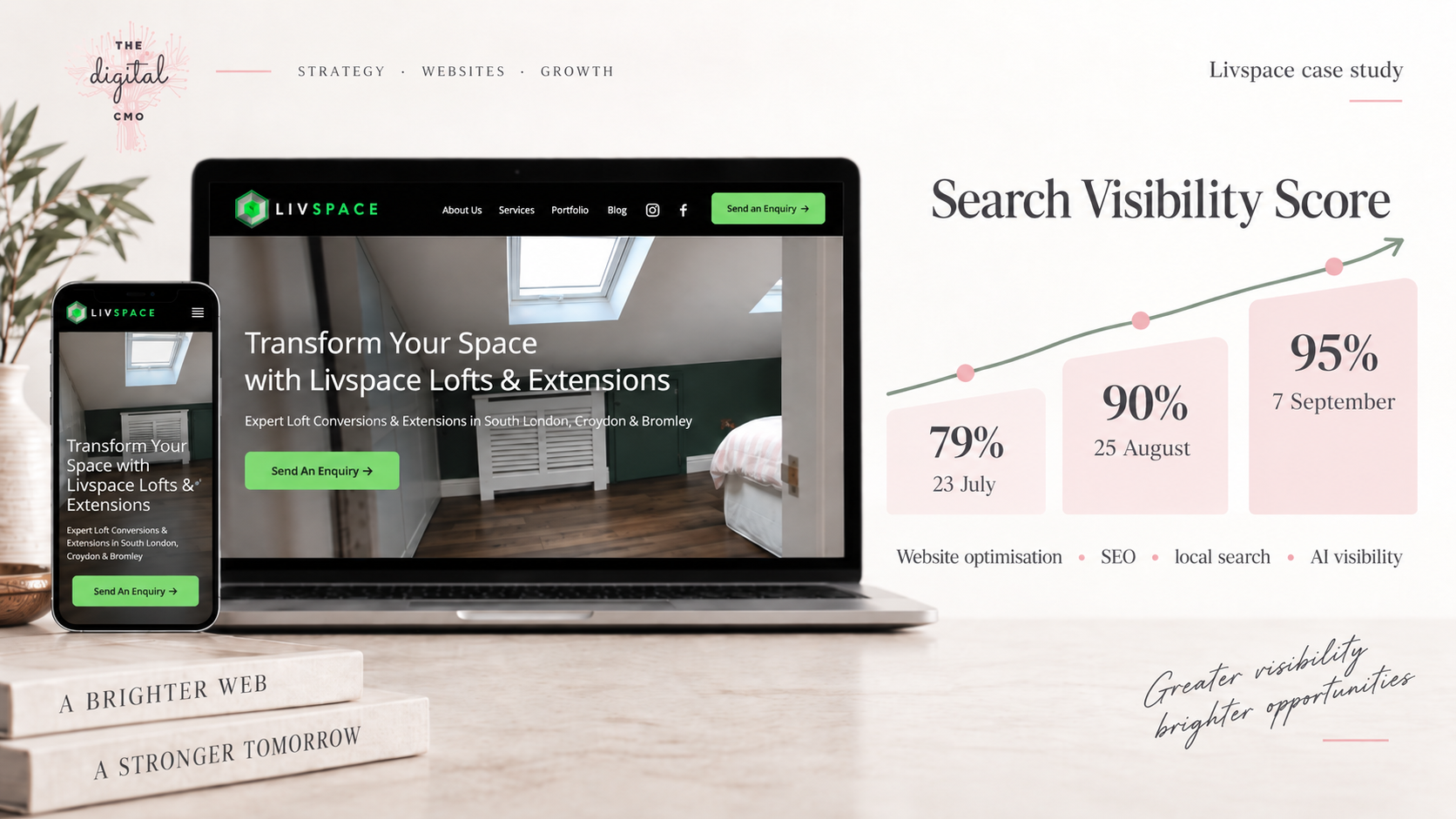
Livspace website with Search Visibility Score growth from 79% to 95%.
I’ve worked with Livspace Lofts & Extensions for a few years now, and our relationship has evolved as the business has.
I originally came on board to support Livspace with social media, but over time my role has expanded to include website copy, content, SEO, and digital strategy.
Last year, Livspace revamped its website in Squarespace, working with another consultant. I wrote the copy and worked with her on the structure. I learned a lot through that process, then built on it myself.
At the time, my own website was still sitting on an older version of Squarespace, so I started teaching myself more about the newer platform, how it worked and how I could get more from it. That eventually led me to revamp The Digital CMO website completely this summer.
What I like about that is that the learning now flows both ways.
The work I’m doing for Livspace is helping me test and refine what I do on my own site, while what I’m learning through optimising The Digital CMO feeds straight back into the work I do for Livspace.
It’s a very hands-on way of working, but that’s exactly how I like it. I’m learning, testing, applying and refining all the time rather than treating a website as something you build once and leave alone.
When the business changes, the marketing should too
Livspace had a very busy summer delivering loft conversions and extensions across South London, so the team’s time was, quite rightly, focused on projects and clients.
Rather than simply doing more of the same marketing activity, I shifted my focus to the website, SEO, local search, AI visibility, and content.
The objective was simple: make it easier for the right people to find Livspace when they were already looking for help.
That meant improving the site, strengthening local SEO, creating useful search-led content and making sure Livspace’s expertise, locations and services were clearly represented.
Creating content that earns its keep
I’m not interested in creating content for content’s sake.
Every piece should have a job to do.
Over the summer, we focused on the kind of questions prospective customers are actually asking: how to plan a loft conversion, what to think about before extending, how to make the most of a small space, what the process looks like and what to consider before starting.
We also strengthened the site's local relevance by ensuring the content reflected the areas Livspace actually works in.
For a local business, that really matters. Someone searching for a loft conversion company in South London wants to know whether you work in their area, whether you’ve completed similar projects and whether you understand the type of property they own.
SEO is about more than keywords
SEO still gets reduced far too often to keywords and blog posts.
In reality, it’s much broader than that.
I also looked at page structure, headings, metadata, internal linking, calls to action and the journey someone takes once they land on the site.
Search behaviour is changing too. People still use Google, but they’re also asking ChatGPT, Gemini and other AI tools for recommendations, explanations and answers.
That means your website needs to make a few things very clear: who you are, what you do, where you do it, what you know about and why someone should trust you.
The results
The results have been measurable.
Livspace’s Search Visibility Score increased from:
79% on 23 July 2026
90% on 25 August 2026
95% on 7 September 2026
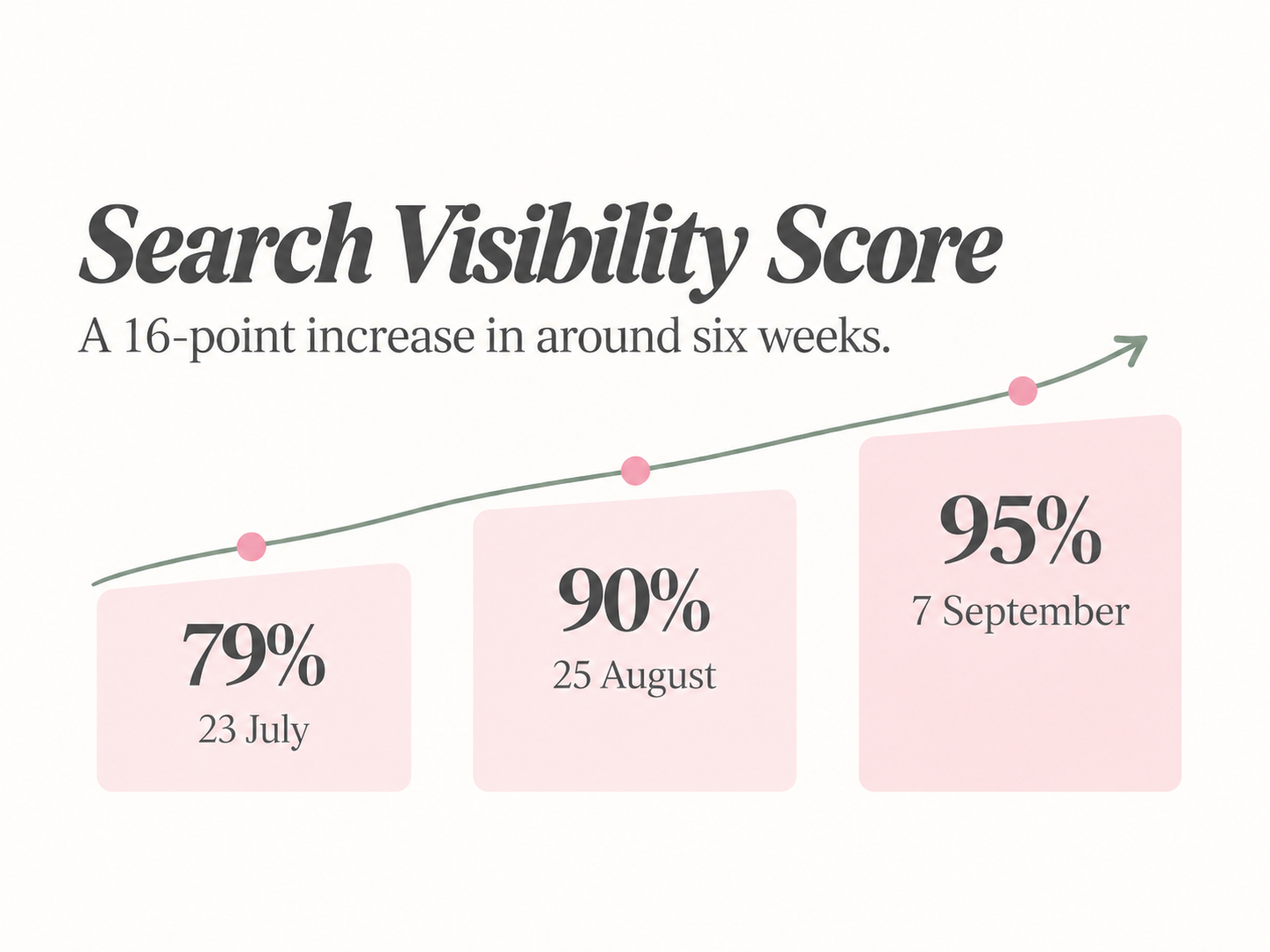
That’s a 16 percentage-point increase in around six weeks!
More importantly, Livspace has also seen an increase in leads and project conversations coming through search.
That’s the bit that really matters.
Marketing is not always about another campaign, another paid ad or another social post. Sometimes the work with the biggest impact happens quietly in the background.
Someone searches for an answer, finds your content, looks at your work, gets a feel for the business and then gets in touch when the time is right. We also believe in the power of a conversation; the website and content need to convey the brand (or, in the case of Nicky’s, personality), which often results in a WhatsApp call and not always a form completion or email.
That is marketing doing its job.
Marketing works better when the pieces work together
I don’t believe small businesses need one magic marketing channel, and they definitely don’t need to be everywhere all the time.
Search, content, social media, email and the website all have different jobs to do, but they work best when they support each other.
Search can bring someone in. Content can build trust. Project pages and Google Reviews can provide proof. Social media can keep the business visible. Email can nurture someone who isn’t ready yet. A well-structured website makes it easy for them to take the next step.
For me, good digital marketing is about making those pieces work together, not treating them as separate tactics.
You don’t need a massive budget
You also don’t necessarily need a huge budget to make meaningful progress.
As a self-employed consultant, I understand the need to pivot. Priorities shift, budgets move, and sometimes the focus has to shift from client delivery to growth activity or back again. That flexibility matters, especially for smaller businesses where time and budget both need to work hard.
Sometimes paid activity is the right move. Sometimes it’s SEO. Sometimes it’s email. Sometimes the smartest thing you can do is improve the website you already have rather than commission something new.
The goal isn’t to do everything. It’s to do the right things in the right order.
Building the autumn and winter pipeline
The work we’ve done over the summer also gives Livspace a much stronger bank of content to use through autumn and winter.
Those articles can continue to bring people in through search, but they can also be repurposed across social media, used to nurture enquiries and sent directly to prospects who need more information before they’re ready to move forward.
So the work isn’t only improving visibility now. It’s also helping support the pipeline over the coming months.
This is how I like to work
My role with Livspace has moved from social media to website copy, content, SEO, local search and AI visibility.
That’s exactly how I think marketing should work. Business needs change; customer behaviour changes; platforms change, and budgets change. The marketing should be flexible enough to change too.
There’s a Venn diagram somewhere between strategy, content and digital optimisation, and that overlap is where I spend a lot of my time.
I can step back and identify the opportunity, then get hands-on with execution when needed.
For Livspace this summer, that meant shifting the focus towards the website, search and content. The result was stronger visibility, more search-led conversations and a bank of useful content that can keep working through autumn and winter.
If your marketing needs a rethink, a reset or simply a sharper focus, I can help you work out what deserves your time and budget right now.
Whether that’s content, SEO, your website, campaign planning or bringing the different pieces together, I work with businesses that need senior marketing thinking without adding another full-time hire.
Let’s talk about what would make the biggest difference next.